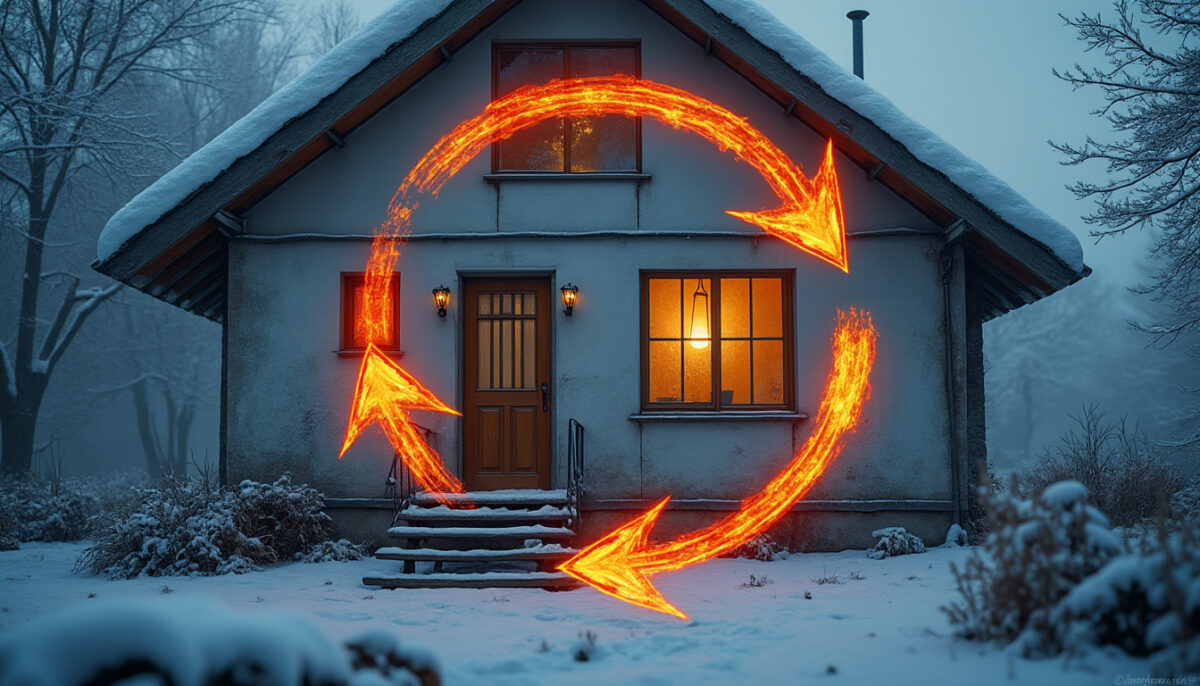
Energy: high heating, poor insulation, a vicious cycle
Hello, this is Claude. Faced with strong heating and poor insulation, the best solution to break this vicious cycle is first and foremost to improve the insulation of your house, because only good insulation will allow you to keep the heat in without skyrocketing your energy consumption.
To do immediately
- Identify the sources of heat loss in your home, including the walls, roof, and windows.
- Install weatherstripping on poorly insulated doors and windows to stop drafts.
- Check and maintain the ventilation to avoid excessive and unnecessarily hot air exchange.
- Balance the temperature of the rooms by avoiding excessive heating which does not compensate for poor insulation.
- Request an energy audit to precisely identify areas for improvement.
To begin, you need to understand that when you heat a poorly insulated house intensely, it’s literally throwing money away. This pattern makes energy bills unsustainable, and thermal comfort is often disappointing because the heat escapes quickly. Improving your insulation is key to increasing energy efficiency. You can find out how. reduce heat loss detecting heat loss in a dwelling.
A well-insulated house prevents heat from escaping through the walls. Without effective insulation, you’ll have to heat the house intensely to compensate for heat loss of up to 30% through the walls and up to 30% through the roof. This heat loss creates a vicious cycle: the more you heat, the more heat escapes without benefiting the occupants. High heating should never mask poor insulation.
To give you an idea, in an old house where the insulation is insufficient, the heating may remain on constantly to maintain a proper temperature, whereas simply insulating the attic or replacing the windows can reduce energy consumption by up to 30% depending on the situation.
The main sources of heat loss
| Element | Share of heat losses (%) | Advice to limit these losses |
|---|---|---|
| Roof/Attic | 25–30 | Attic insulation with mineral wool or ecological materials |
| Walls | 20–25 | Interior or exterior insulation, or wall lining |
| Air leaks and ventilation | 20–25 | Sealing of openings, maintenance of mechanical ventilation systems |
| Windows | 10–15 | Double or triple glazing adapted to the region |
| Low floor | 7–10 | Floor or basement insulation, installation of an insulating floor |
Breaking the vicious cycle: Insulation then heating
If this is your first renovation: start by insulating the attic and walls, as these areas have the greatest impact on your energy consumption. If you already have basic insulation, improve it or replace it with suitable materials to prevent dampness and settling. Replacing single-glazed windows with double or triple glazing will perfectly meet your energy needs.
Heating should be seen as a supplement, not a replacement. Excessive heating in a poorly insulated house creates a vicious cycle: heat is produced but not retained. One might think that high heating will increase comfort, but this is not the case without proper insulation.
3 simple steps to regain control of your energy consumption
- Step 1: Conduct an energy audit to precisely identify weaknesses and air leaks.
- Step 2: Prioritize insulating the attic and walls, and replace the windows if necessary.
- Step 3: Optimize your heating with a suitable setting and possibly a programmable thermostat to avoid overheating.
The lasting benefits of good insulation
The good news is that investing in insulation improves your comfort while lowering your energy bills. It also adds value to your property. As the saying goes, “You can’t properly heat a house that leaks like a sieve.” By 2026, insulation technologies are evolving towards more environmentally friendly and efficient materials, making renovation easier.
Furthermore, regular maintenance of the insulation contributes to its long-term effectiveness: a simple re-blowing of glass wool or checking of the joints can raise the temperature by several degrees without additional consumption.
Prioritize to avoid getting lost in the work
- Insulate the attic first, as it is often the main source of heat loss.
- Control and seal air leaks around windows and doors.
- Replace single-glazed windows with high-performance double or triple glazing.
- Maintain and adjust ventilation to avoid excessive heat loss.
- Install a programmable heating system, without resorting to conventional heavy heating.
What can you expect after the renovation?
Thermal comfort in your home will be significantly improved, with a more stable temperature and a gentler feeling of warmth, thanks to fewer cold surfaces. Energy consumption will often decrease by 20 to 40%, depending on the quality of the work and the geographical area. The vicious cycle will be broken: you pay less and enjoy more.
If your home is old, a thermal study can also identify areas at risk of mold growth due to poor air renewal, which you can correct with efficient ventilation combined with insulation.
The crucial role of ventilation in preventing heat loss
Controlled ventilation is essential to prevent humidity and improve indoor air quality without losing valuable heat. Modern systems like dual-flow mechanical ventilation recover heat from the outgoing air to warm the incoming air. This maintains an ideal balance between thermal comfort and air renewal.
Approximate distribution of heat losses according to the ADEME study
| Job | Average share of losses (%) | Involvement in renovation |
|---|---|---|
| Roof | 25-30 | Reinforced insulation |
| Walls | 20-25 | Interior or exterior insulation |
| Air leaks | 20-25 | Caulking |
| Windows | 10-15 | Glass replacement |
| Low floor | 7-10 | Floor/crawl space insulation |
Some tips to limit heat loss without major renovations
- Use thick curtains at night to limit convection in front of the windows.
- Installation of the sealing strips at the bottom of the doors.
- Close the shutters at night to reduce heat loss through the windows.
- Adjust your heating room by room to avoid heating unused areas.
- Consider using rugs on cold floors for an immediate noticeable benefit.
Why is heating at high temperatures not enough if the insulation is poor?
Heating a poorly insulated house often results in wasted energy: the heat produced quickly escapes through the walls, windows or roof, forcing you to constantly increase the heating without achieving real thermal comfort.
How to detect the main sources of heat loss in your home?
Heat loss can be detected by drafts, cold walls, condensation on windows, or a feeling of cold despite the heating being on. Tools such as infrared thermography and blower door testing, performed by a professional, can precisely identify these areas.
What are the recommended insulating materials for an effective renovation?
Fiberglass and rock wool remain economical and effective options for insulating attics and walls. Polyurethane or expanded polystyrene panels are also effective, particularly for floors. The choice depends on budget, accessibility, and the desired performance.
What financial assistance is available to help insulate my home?
Several forms of assistance are available in 2026, including MaPrimeRénov’, the zero-interest eco-loan, and a reduced VAT rate. These schemes are often subject to conditions, but they facilitate access to effective and affordable energy renovation.
How can ventilation be optimized to reduce heat loss?
Installing a dual-flow mechanical ventilation system (MVHR) allows for the renewal of indoor air while recovering heat from the extracted air. This prevents excessive air exchange, which would unnecessarily cool the house.
Thank you for your interest; Claude