
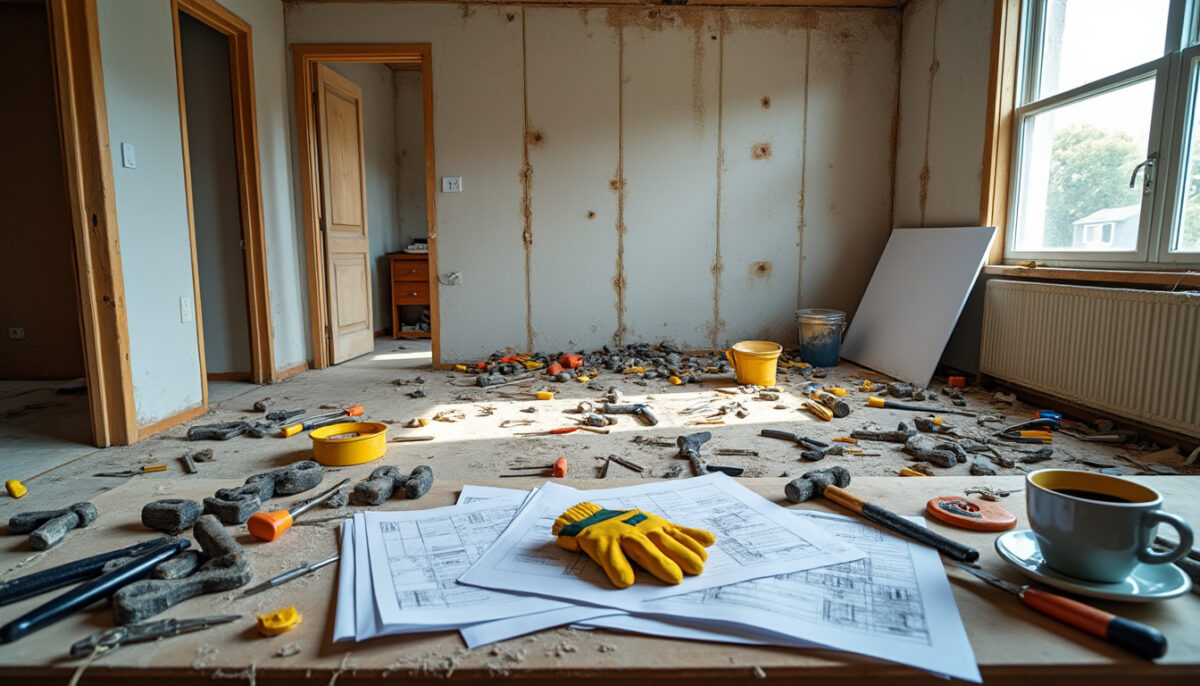
Autonomy: before starting work, avoid this bad order
To do immediately
- A complete structural and network diagnosis was carried out prior to demolition.
- Check the condition of the load-bearing walls, humidity and existing installations.
- Plan the logistics and site safety rigorously.
- Prioritize demolition, structural work, then finishing work in a strict order.
- Prepare a detailed budget with a margin for unforeseen events.
To fully master the order of interventions, it is helpful to consult a clear guide such as the one on house work guide or even discover the importance of order of renovation workThese resources will help you avoid the most common mistakes on a construction site.
Why preparation and planning ensure your autonomy in your work
Preparation is the crucial step that guarantees your independence on the construction site. Without rigorous observation of the building and a preliminary assessment, you risk having to redo work already completed, which puts a significant strain on your budget and time. Effective site management begins with identifying critical points: load-bearing walls, moisture, electrical wiring, plumbing, and insulation. These checks dictate the order of intervention and allow you to anticipate potential problems.
If it’s an old house, a thorough inspection is essential. Conversely, for a more recent building, the work will often be less extensive but will still include checking the utility networks.
Priorities to check before demolition
| Element | To control | Recommended action |
|---|---|---|
| Structure | Cracks, settlements, wall alignment | Consult a structural engineer |
| Humidity | Stains, mold, leaks | Treat before partitioning |
| Electricity | Electrical panel, sockets, grounding | Upgrade to necessary standards |
| Plumbing | Condition of drainage systems and pipes | Replacement or reinforcement |
| Insulation | Thermal bridges, thickness | Choosing suitable insulation |
Optimal organization: order of work and safety
Before undertaking major work, an organizational structure must be put in place to secure the worksite and optimize the management of all parties involved. This includes clearly defining work zones, protecting undamaged areas, and calling in the appropriate professionals for each stage. Obtaining the necessary local permits is also essential to avoid any delays.
Following a logical order often means starting with demolition from top to bottom. Next, work on the structural elements, the technical systems (plumbing and electrical), then the screed, and finally the finishing touches. This sequence reduces the risk of rework, facilitates coordination, and ensures maximum efficiency. “Good organization saves time,” emphasizes Julien D., an experienced tradesman.
Coordinating plumbing, electricity and insulation for lasting independence
Energy and functional self-sufficiency depend heavily on the coordination between plumbing, electricity, and insulation. These installations must precede partitioning and finishing to avoid significant rework. The installation of conduits, water supply and drainage systems must be precisely planned in conjunction with the choice of equipment and insulation materials. All of this will result in a smooth construction process and a home better prepared to offset its costs and environmental impact.
If it is an energy renovation, prioritizing bio-based insulation helps not only with thermal performance but also with ecological sobriety.
An effective procedure to get your projects off to a good start
- Step 1: Conduct a comprehensive diagnostic to identify technical priorities.
- Step 2: Organize the logistics of the construction site with enhanced security and permits.
- Step 3: Start the work in the following order: demolition, structural work, technical networks, insulation, finishing touches.
Why is it crucial to carry out a diagnosis before work begins?
The diagnosis allows us to anticipate costs and difficulties, thus avoiding costly interventions and unnecessary rework.
What order should be followed to launch an effective renovation?
Demolition from top to bottom, then structural work, technical installations, insulation, and finishing touches. This order optimizes site management.
How does preparation improve autonomy during work?
Good preparation secures the construction site and plans the logistics, reducing interruptions and facilitating the independence of the stakeholders.
Is it always necessary to redo the electrical installations and plumbing?
Not always, but it is often recommended to comply with current standards and avoid future problems.
How important is it to choose the right insulation materials?
Appropriate insulation materials, ideally bio-based, improve thermal performance and reduce ecological impact.
Thank you for your interest; Claude