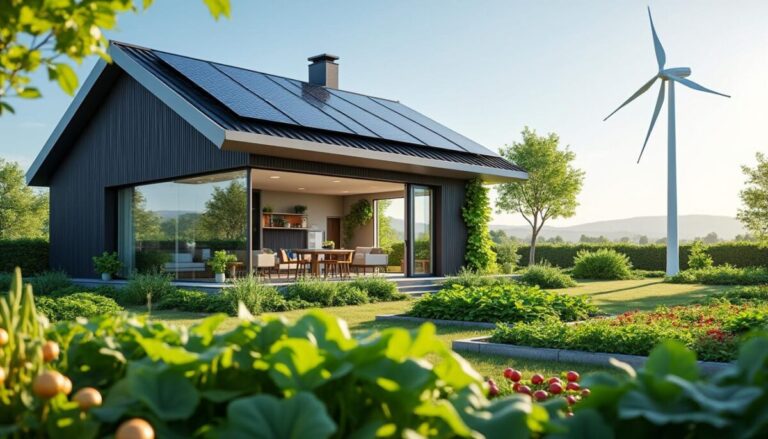

Self-sufficiency: local materials or prolonged dependence
Hello, this is Claude. To become more self-sufficient, we must first prioritize local materials to limit our dependence on external resources while strengthening the durability of our homes. This helps us build responsibly, reduce our carbon footprint, and support the local economy—essential for a more resilient and self-reliant lifestyle.
To do immediately:
- Choose natural materials such as raw earth, straw or local wood for your renovation or construction projects.
- Reduce your energy consumption by adopting simple and economical solutions.
- Prioritize the recovery and recycling of materials to reduce your dependence on industrial circuits.
- Install a rainwater harvesting system to limit your consumption of mains water.
- Join a local permaculture or exchange network to share resources and advice.
To learn more, discover how renovate without depending and tips for an older, more understated house, two key resources that complement this approach well.
Self-sufficiency and the choice of local materials: a lever for reducing dependence
Using local materials is not only environmentally friendly, it’s a strategic decision that promotes self-sufficiency and resilience in the face of economic uncertainties. Wood, straw, earth, or stone extracted nearby reduces energy costs associated with transportation and strengthens ties with the local economy.
A resident of a rural area chose straw for his home’s insulation. As a result, he significantly reduced his heating needs and avoided costly reliance on fossil fuels. This approach also promotes sustainability, as these materials are often biodegradable and recyclable.
However, we must remain realistic: depending on the area, some resources will be more accessible than others, and it will probably be necessary to supplement them with more technical materials to guarantee comfort and safety.
Make the best possible use of available natural resources
Before starting a project, it is crucial to identify local resources that are available and suited to the climate and soil. A good resource map can guide the choice between raw earth, wood from sustainably managed forests, stone, or straw.
Next, integrating these materials into a suitable construction system (such as eco-construction) ensures sustainability and resource conservation.
- Promotes short supply chains for the purchase of materials.
- It uses traditional construction techniques that optimize their use.
- Combines local materials with modern equipment for energy efficiency.
- Recycle construction waste to limit losses.
- Test the materials before use to ensure their performance in your environment.
Prolonged dependency: an obstacle to lasting autonomy
Often, reliance on imported materials or non-renewable resources hinders material and energy self-sufficiency. This perpetuates a prolonged dependence on suppliers and a globalized system that is difficult to escape.
Managing this dependency requires rethinking practices to integrate the circular economy and prioritize recycling. Reducing the consumption of complex and unsustainable materials is possible with a good choice of local and natural materials.
A quote from the philosopher Kant resonates here: “The essential thing is not in the actions that one sees, but in those inner principles of actions that one does not see.” This reminds us that our desire to act locally and simply is already a step towards autonomy.
How to move towards greater material independence?
- Step 1 : Identify your actual material needs and assess which ones you can substitute with premises.
- Step 2 : Seeks local partners and promotes the region’s natural resources.
- Step 3 : Implement construction techniques that maximize sustainable use and energy efficiency.
Comparative table of local materials vs. imported materials
| Criteria | Local Materials | Imported Materials |
|---|---|---|
| Environmental cost | Weak, reduction of transport and carbon footprint | High, dependent on international transport |
| Sustainability | Good, often biodegradable and repairable | Variable, often less repairable, problematic end of life |
| Local economy | Reinforced, creation of local jobs | Little direct impact on the local economy |
| Thermal performance | Adapted to the local climate, good insulation | Perhaps more efficient but energy-intensive to produce |
| Accessibility | Depends on regional resources | Available in large quantities but often expensive in the long run |
Autonomy and dependence: a nuance to understand
Being autonomous does not necessarily mean being 100% independent. Dependence often manifests itself in physical actions, but autonomy is also the ability to decide for oneself, even when needing help for certain tasks. Understanding the difference between dependence and loss of autonomy is an essential step to better support and respect each person in their situation.
Initiatives like the Citizenship promote this relational autonomy by combining respect for personal decisions with daily support.
Is it possible to be autonomous without being completely physically independent?
Yes. Autonomy mainly concerns the ability to make decisions, while dependence can concern daily physical activities.
Which local materials should be prioritized for a sustainable home?
Raw earth, straw, local wood and natural stones are often preferred for their availability, durability and low environmental impact.
What surface area is needed for food self-sufficiency?
In general, between 1000 and 1500 m² per person are needed depending on local productivity and the cultivation techniques adopted.
How to limit energy dependence?
Adopting autonomous systems such as solar panels, wood stoves, rainwater harvesting and reducing consumption through energy sobriety.
Thank you for your interest; Claude