
Self-sufficiency: a simpler, older house without gimmicky solutions
Hello, this is Claude. An off-grid home, even an older one, can remain simple, comfortable, and efficient without getting carried away by expensive gadgets or overly complex solutions. The key is to prioritize energy sobriety combined with suitable equipment, in favor of a sustainable rehabilitation and a eco-construction respectful. The secret lies in natural insulation, simple and reasoned energy management, and intelligent self-management of needs.
To do immediately
- Reinforce insulation with natural materials to limit heat loss.
- Optimize heating through passive and efficient solutions.
- Install photovoltaic solar panels suitable for the roof.
- Promote a vegetable garden and rainwater harvesting for greater self-sufficiency.
- Getting closer to a local exchange network to capitalize on pooling resources and mutual support.
sustainable rehabilitation and energy efficiency And self-sufficient house without gadgets they are deepening these approaches.
Self-sufficiency in an old house: aim above all for simplicity
The challenge in an older home is first and foremost to control energy consumption by reducing needs. Effective renovation relies on high-performance natural insulation, such as hemp wool or cellulose wadding, which provides thermal comfort without invasive technological solutions. Energy efficiency also means considering passive comfort: appropriate orientation, sun protection, and natural ventilation. A well-renovated older home can reduce its energy bills by up to 50%, and this without unnecessary gadgets.
If the house is in a rural area, for example, rainwater harvesting and a small vegetable garden improve family self-sufficiency. In an urban area, focus on insulation and opt for simple equipment to avoid excessive costs. Sometimes, less is more: a well-designed, simple house will always be more resilient than one overloaded with inconsistent technology.
Producing some of one’s own energy without resorting to technological one-upmanship
Installing photovoltaic panels on a well-exposed roof remains the most accessible solution for achieving energy independence. But it’s not about gadgets; it’s a strategy: producing some of your own electricity to reduce dependence on the grid and control your budget.
A completely self-sufficient house is rarely financially viable and requires complex management. The goal is a pragmatic partial autonomy With a solar system sized according to actual consumption, coupled with energy-efficient equipment such as a high-efficiency heat pump. Rather than accumulating systems and gadgets, make the effort to centralize energy management for greater simplicity.
Sustainable renovation: how to transform your old house into a haven of comfort without gadgets
Starting a renovation means avoiding the mistake of buying an expensive gadget. Here’s how to hit the bullseye:
- Step 1: Accurately assess energy needs and identify weak points in the building envelope (walls, roof, windows).
- Step 2: Reinforce natural insulation and improve ventilation for passive comfort in summer and winter.
- Step 3: Install simple renewable energy production solutions tailored to your home to reduce your energy bills.
This method avoids massive construction projects and allows you to progress at your own pace, adapting techniques to the environment as best as possible. Today, home automation also exists in a practical form: controlling heating, lighting, or energy consumption, but avoiding complicated gadgets that end up gathering dust in a drawer. For a harmonious blend with the older house, prioritize simplicity and durability.
A table to better understand the true cost difference between autonomy and self-sufficiency
| Criteria | Self-sufficiency (isolation) | Autonomy (cooperation) |
|---|---|---|
| Workload | Very high | Distributed across a local network |
| External dependency | Masked, but present | Assertive, with exchange |
| Resilience | Vulnerable to unforeseen events | Stronger thanks to pooling resources |
| Initial cost | Often high and unique | Progressive and controlled |
| Quality of life | Possible isolation | Collaborative and fulfilling |
The practical garden: simplicity extends to the exterior as well.
The garden should no longer be just a picture postcard. With raised garden beds, rainwater harvesting, and appropriate planting, it becomes a true ally for sustainable living. It creates natural coolness and provides a degree of food self-sufficiency, while also promoting local biodiversity.
It doesn’t require a large plot of land, just simplicity and a little willpower. As Margaret Mead said: “Never doubt that a small group of thoughtful, committed citizens can change the world.”
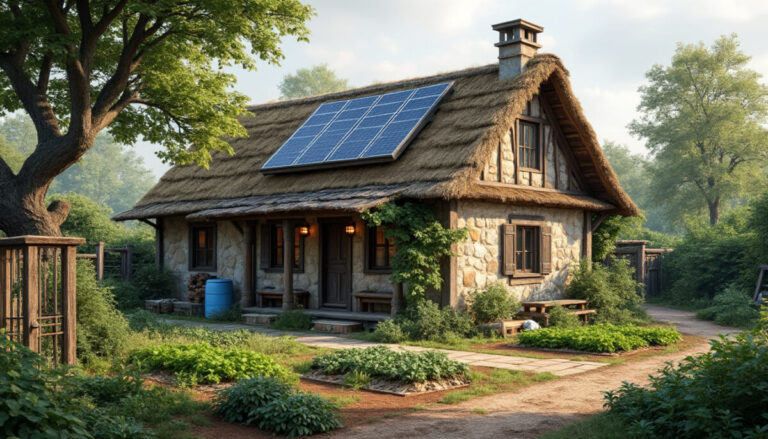
A well-designed vegetable garden area in the heart of a simple and productive garden.
This return to nature is also a calming response to a world often connected to senseless overconsumption. Having a few herbs, tomatoes, and some seasonal vegetables re-establishes a direct link with your home.
Anticipate and act: 5 key tips for successful autonomy
- Reduce heat loss by improving natural insulation and ventilation.
- Choose energy-efficient equipment and adapt them to your situation (heat pump, high-performance wood stove).
- Produce your own energy progressively with solar energy, prioritizing appropriate sizing.
- Enhance your garden to create a space that nourishes, refreshes and restores biodiversity.
- Join or create a local network to exchange tools, advice and resources, promoting collective autonomy.
What is a self-sufficient, low-energy house?
It is a dwelling that combines energy efficiency, high-performance natural insulation and partial renewable energy production, without relying solely on complex technological solutions.
Is home automation necessary in a simple, old house?
Not necessarily. It must remain a simple tool for effectively managing energy needs without complicating or burdening daily operations.
How to prioritize tasks for greater autonomy?
Start with natural insulation and reducing energy needs, then gradually add renewable energy production according to your budget and situation.
Can an old house truly achieve self-sufficiency?
Yes, by combining sustainable rehabilitation, ecological materials and suitable equipment, without seeking total self-sufficiency, but pragmatic and resilient autonomy.
What materials should be preferred for natural insulation?
Hemp wool, cellulose wadding and wood are sustainable choices that improve passive comfort without using costly artificial solutions.
Thank you for your interest; Claude