
Materials: water storage, a good idea or a major constraint
Hello, this is Claude. A storage aggregate layer is a good solution if the materials, soil-bearing capacity and maintenance are considered from the outset; otherwise, it can become a costly liability.
This underground structure supports a surface used every day while temporarily retaining rainwater. The choice depends mainly on the volume to be managed, the type of surface covering and whether water can infiltrate on site.
What to do right away
- Identify which surfaces will drain rainwater to the storage layer: parking area, roof, patio or path.
- Have the soil’s permeability and the water table depth checked before planning for infiltration.
- Choose a material compatible with the expected loads and the desired storage volume.
- Plan access to inspection chambers, settling devices and drains to make maintenance easier.
- Check local planning and stormwater management rules before starting work.
To compare temporary storage beneath a developed surface with collection in a tank, you can consult this guide to the limits of rainwater self-sufficiency and the advice on how to install a rainwater collector.
Storage aggregate layer or rainwater collection tank: two different uses
A storage aggregate layer receives rainwater, temporarily holds it in its voids, then allows it to infiltrate or discharges it at a controlled rate. It therefore helps limit peak runoff while also serving as a foundation for a parking area, roadway or patio.
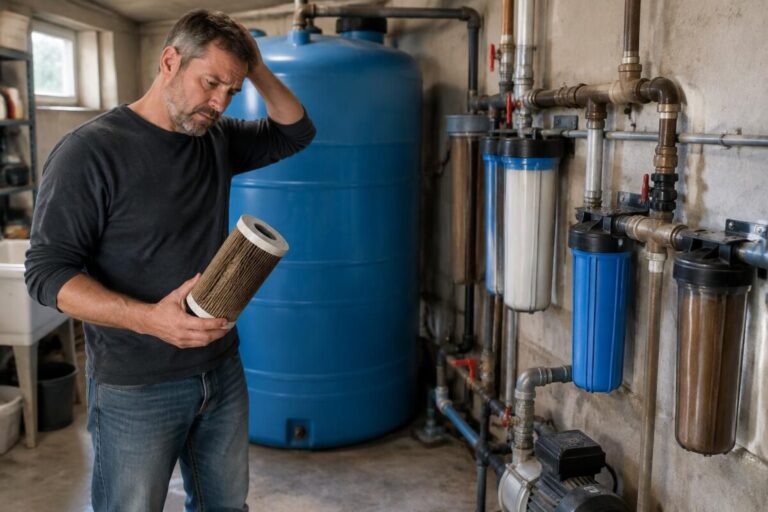
A rainwater collection tank, on the other hand, stores water in a watertight reservoir for later use, such as watering plants. The storage layer is primarily used to manage rainwater on site; it is not a domestic water supply that is directly available for use.
Gravel, expanded clay or cellular modules
The material determines the volume of water temporarily stored, as well as the mechanical strength and installation cost. As an indication, voids account for about 30 to 40% of the volume of 20/60 aggregate, 40 to 55% for expanded clay and 90 to 95% for ultra-light cellular structures, or SAUL.
| Material | Indicative void ratio | Point to consider |
|---|---|---|
| 20/60 aggregate | 30 to 40% | Common mineral material; choose a washed grade suitable for the loads. |
| Expanded clay | 40 to 55% | A load-bearing layer may be needed beneath a trafficked surface. |
| SAUL modules | 90 to 95% | High storage capacity, but the design and access for maintenance must be planned. |
These ratios alone are not enough to size the structure: the actual usable volume also depends on its geometry, water inflow and discharge method. For a driveway or roadway, the choice must balance storage capacity and vehicle load resistance.
Gravel offers a mineral-based solution, while prefabricated modules can store more water in a given space. To assess durability and carbon footprint, also consider the materials’ origin, their transportation and their service life, not just their storage volume.
Water inflow and discharge: how the water flows
With direct inflow, a permeable surface covering—such as porous pavers or permeable concrete—allows rain to pass through the surface. The water then reaches the underlying structure, limiting the entry of large debris if the surface is properly designed and maintained.
With indirect inflow, an impermeable surface covering directs water to inlets, then drains carry it into the storage layer. In this case, settling or filtration must be provided to retain material that could clog the pipes.
The water can then infiltrate into the soil, be conveyed to an outlet at a controlled rate, or follow a mixed approach. If the ground has low infiltration capacity, an outlet drain may be needed; if a landscaped swale is already in place, it can supplement the storage.
Constraints to consider before work begins
A common pitfall is choosing a highly capacious material without checking the strength of the surface above it. Beneath a trafficked area, a storage layer about 60 cm deep is often planned when using aggregate, but the design must be confirmed based on the soil, loads and local regulations.
Protection against fine particles is just as important. The aggregate must be clean and, for an infiltration storage layer, a continuous geotextile wrap can prevent soil particles from entering the structure and reducing its capacity over time.
The groundwater table, nearby trees, non-watertight basements and any soil contamination must also be taken into account. A distance of about 1 m between the bottom of the structure and the water table is indicated in some technical guides; site conditions and applicable regulations should still be checked.
Maintenance is not optional: grates, inlets, inspection chambers and settling tanks must remain accessible. An inspection at least twice a year is a useful guideline for injection systems, to be adjusted according to rainfall and observed deposits; drains may require regular inspection and high-pressure water jetting.
A practical example beneath a parking area
For a small condominium parking area, a storage layer beneath the parking spaces can avoid having to set aside a large area of land for a basin. Permeable pavers feed water directly into the structure; an overflow or controlled-flow drain takes over if the soil cannot absorb the water quickly enough.
The space-saving benefit is appealing, but the project must account for vehicle loads, access for drain cleaning and the management of water that may contain pollutants. A preliminary study helps prevent a discreet solution from becoming a structure that is difficult to repair.
To move forward simply, follow these three steps:
- Assess the site: record the contributing surfaces, uses, loads, soil type and water table depth.
- Compare the solutions: choose the material, void ratio, surface covering and discharge method with a professional.
- Plan for service life: include inspection chambers, cleaning, inspections and maintenance costs in the overall budget.
A storage aggregate layer can therefore be an effective solution for water resource management, particularly when space is limited. Its success depends less on choosing the theoretically highest-performing material than on coherent design, careful installation and accessible maintenance.
Frequently asked questions about materials and water storage
Can a storage aggregate layer allow rainwater to be reused?
Not directly in most cases. Its primary purpose is to store water temporarily, then allow it to infiltrate or discharge it at a controlled rate. To reuse the water, a suitable collection tank is generally required.
Which material provides the most storage?
SAUL cellular modules have a high void ratio, often around 90 to 95%. However, the choice must take into account the loads, soil, installation cost and maintenance requirements.
Is it always necessary to install geotextile?
For an infiltration storage layer, a continuous geotextile wrap is often provided to limit the entry of fine particles. However, the choice depends on the soil and the project and should be determined by the technical study.
How often should the structure be maintained?
Injection systems should be inspected regularly; at least two visits per year is a practical guideline. Heavy rainfall, deposits and site conditions may require more frequent maintenance.
Thanks for reading! Feel free to share your thoughts in the comments. — Claude