
Lightweight materials for simple constructions
Hi, it’s Claude. To build lightweight, first choose according to the intended use: a timber frame for a properly engineered structure, boards on a frame for a partition, or cellular concrete for certain masonry projects. The lightest material is not automatically the strongest or the cheapest once installed. Here’s how to compare them without confusing structure, facing and insulation.
In this article, we’ll take a look at materials that make construction easier while providing remarkable strength. I also recommend checking out a few tips on how to insulate your home with unexpected materials and how to recycle materials to renovate your home—they might give you some ideas for optimizing your project. As a bonus, a YouTube video to help you visualize the possibilities of simple construction using lightweight materials will be included further down.
Wood and natural materials: lightness and durability
Wood is undoubtedly one of the champions among lightweight materials for simple construction. Its versatility makes it quick to work with, while modern techniques such as glued laminated timber provide excellent mechanical strength. Modular timber structures are increasingly popular, particularly for small homes and extensions. Bamboo, another lightweight material, combines aesthetics with strength; it grows quickly and is an essential renewable resource. For a bamboo project, check the available supply chain, treatment and technical documentation: it is not an automatic substitute for structural timber.
A panel does not necessarily serve every purpose: OSB used for bracing must have a grade, thickness and fasteners specified for that use. Hemp wool provides insulation, but does not replace a load-bearing component. The DREAL-published Osez le bois guide outlines the possibilities of timber structures; each project still needs its own calculations.
Aluminum and lightweight metals: strength and ease of assembly
Let’s move on to lightweight metals: aluminum is becoming increasingly popular in the construction sector thanks to its featherweight and natural resistance to corrosion. Aluminum profiles can form lightweight frames if their sections and connections are designed to withstand the expected loads. It’s an excellent choice for modular structures intended to be dismantled or modified. Steel can be used to form a slender, strong frame; its overall impact depends on the manufacturing process, the quantity used and whether it is reused.
Moreover, combining aluminum with composite panels considerably reduces the weight of modules, but thermal and acoustic insulation depends on the makeup of the entire wall assembly. Metals conduct heat, so thermal bridges must be addressed. This is ideal for building quickly without sacrificing quality, particularly for temporary housing or small, simple buildings. For a practical and sustainable approach, you can also find out how local materials can influence your renovation.
Innovative insulation for lightweight, comfortable structures
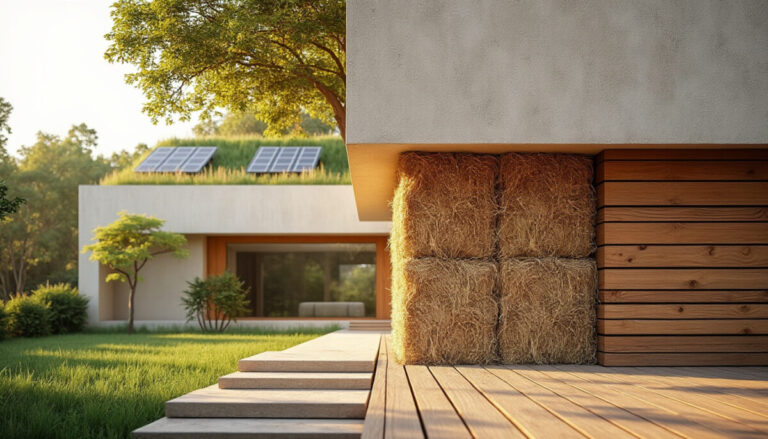
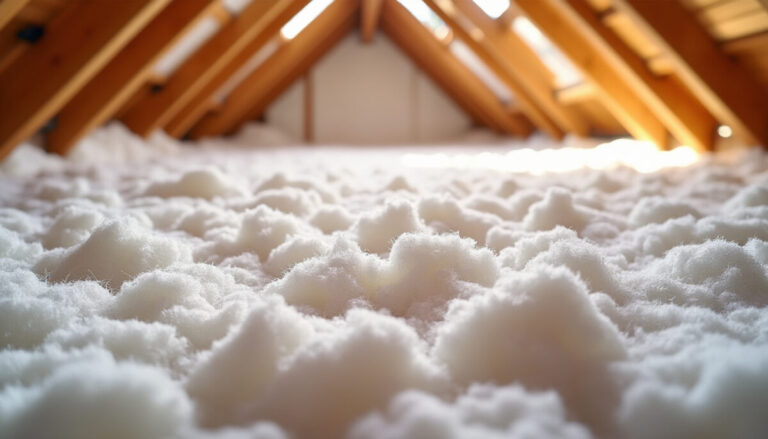
Choosing the right insulation is key to ensuring comfort and energy efficiency in a simple construction project. Natural insulation made from plant fibers, such as straw, hemp or cork, provides lightness and excellent insulation. Cork, for example, is not only eco-friendly but also highly effective against moisture, making it ideal for sensitive areas. Hemp fiber insulation boards serve an insulating function; do not assume they can bear loads.
A practical tip: some unexpected materials, such as perlite or vermiculite, can be incorporated into lightweight concrete or insulating mortars, improving thermal regulation while reducing the weight of walls. This approach is worth considering to maintain a good balance between lightness, ease of assembly and performance. Finally, take a look at how your concrete wall keeps out the cold to learn more about insulation used with heavy materials, which can surprisingly be adapted to simple construction projects.
Comparing lightweight materials: uses and limitations
| Material | Properties | What to check | Typical use |
|---|---|---|---|
| Bamboo | Lightweight, high mechanical strength | Treatment, connections and technical supply chain | Roof framing, furniture |
| Glued laminated timber | Tensile and compressive strength | Calculated section and water protection | Wall and roof structures |
| Aluminum | Lightweight, corrosion-resistant | Connections, expansion and thermal bridges | Roof framing, frame |
| Composite panels | Performance varies depending on composition | Permitted use, fire safety and fasteners | Cladding, partitions |
| Natural insulation (hemp, cork, straw) | Thermal and acoustic insulation | Thickness, moisture and product footprint | Wall and roof insulation |
| Plasterboard on a frame | Lightweight dry partition | Reinforcement for suspended loads, acoustics, damp areas | Non-load-bearing interior partition |
| Cellular concrete | Relatively lightweight masonry | Weight per m², substrate, thickness and suitable anchors | Partition or project-specific construction, depending on the product |
How can you compare affordable, lightweight and strong materials?
Compare the cost of the completed assembly: material, frame, fasteners, insulation, finishes, transport and tools. For a partition, check the weight per m² of the complete system, not just that of a board. If you have an old floor, have its load capacity checked. For example, 10 m² of a system rated at 40 kg/m² already weighs 400 kg, excluding any additional loads.
The manufacturer Siporex specifies the uses and fasteners for cellular concrete: its blocks are lighter than some conventional masonry materials, but the right choice depends on the substrate and the project. Request the technical data sheet for the exact product. A kit or material that is easy to cut does not eliminate the need to consider anchoring, wind stability and roof loads.
Practical tips for reducing your environmental footprint
Reducing a structure’s weight can cut certain transport requirements or material quantities, but it does not guarantee a better carbon footprint. Compare service life, manufacturing, treatments and reuse options. Recycled, local and renewable materials are often preferred. Don’t hesitate to learn more or seek advice about the actual durability of materials, as Claude explains in one of his popular articles, this miracle material ages in three years—understanding longevity helps avoid unpleasant surprises.
To move forward simply, define the intended use, compare two complete systems, then check that they are compatible with the building. Mixing materials without specifying how they should be installed can actually make the project more complicated.
Which lightweight materials are ideal for simple construction?
There is no one-size-fits-all choice: timber sized for a frame, boards on a frame for a partition, or cellular concrete for certain projects. Insulation materials do not replace load-bearing materials.
How can you ensure the mechanical strength of a lightweight structure?
Check the structural calculations, connections, anchors and loads specific to your project. Lightness and modularity alone do not prove stability.
Are lightweight materials suitable for all types of climate?
The system must be suited to exposure to water, wind, snow and temperature fluctuations. Check the technical documentation and have structural choices approved.
Is ease of assembly an important consideration?
Absolutely. Lightweight materials are often chosen for their quick installation, which also reduces costs and the environmental impact of the construction project.
Can recycled materials be used in lightweight construction?
Yes, recycled steel and some composite panels incorporate recycled materials to reduce their environmental footprint while maintaining performance.
Thanks for reading; Claude