
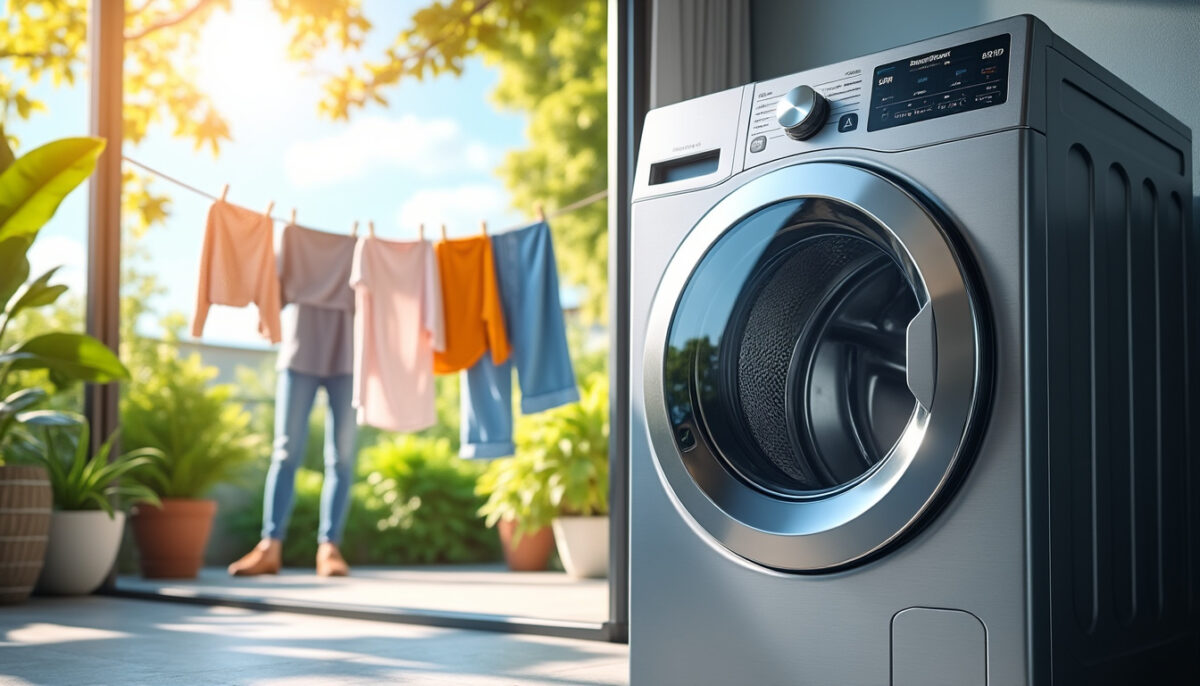
Eco-friendly actions: does the tumble dryer ruin your efforts?
Hello, this is Claude.
The tumble dryer can quickly become a major source of electricity consumption, but if chosen and used correctly, it doesn’t necessarily ruin your efforts to reduce your environmental impact.
Eco-friendly tips to control the electricity consumption of your tumble dryer
The tumble dryer is often seen as an enemy of energy saving, with average consumption in France between 200 and 500 kWh per year
To do immediately
- Choose a heat pump tumble dryer; it consumes up to 50% less energy than a traditional model.
- Uses automatic programs with humidity sensors to prevent over-drying.
- Spin your laundry well at high speed before drying (minimum 1000 rpm).
- Do not overload the drum, this lengthens the cycles and increases consumption.
- Schedule your drying during off-peak hours to save on your bill.
To delve deeper into this topic, discover how to choose an economical and ecological appliance or learn maintenance tips to maximize the lifespan of your tumble dryer.
Tips for choosing an economical tumble dryer And laundry care and eco-friendly practices recommended.
Understanding the environmental impact of tumble dryers
Each kilowatt-hour consumed generates on average 0.06 kg of CO2Thus, a tumble dryer consuming 400 kWh per year equates to approximately 24 kg of CO2 emitted annually. This reflects a persistent dependence on non-renewable energy sources despite the growth of green energy. In addition to emissions, electricity production can disrupt local ecosystems, affecting flora and fauna through pollution and habitat alteration.
If you live in an apartment without outdoor space or in an urban area, a tumble dryer is often essential for practical reasons. However, if you’re lucky enough to have outdoor space or a well-ventilated area, air drying is the best option to reduce your environmental impact.
Modern technologies to limit energy consumption
For the past few years, heat pump dryers have dominated the market thanks to their improved energy efficiency. They reuse heat, drastically reducing electricity consumption. Humidity sensors also play a key role by automatically stopping the appliance when the laundry is dry, thus preventing energy waste and premature damage to textiles.
Condenser dryers, although slightly less common, offer efficient drying that reduces water and energy consumption thanks to their closed-loop system. Choosing one of these technologies represents a real step forward in combining practicality, savings, and sustainability.
| Type of tumble dryer | Estimated electricity consumption | Benefits | Disadvantages |
|---|---|---|---|
| Vented tumble dryer | 400-500 kWh/year | Often low price, simple operation | Very energy-intensive, high carbon footprint |
| Condenser dryer | 250-400 kWh/year | Good energy/water compromise, easy installation | Light, regular maintenance of the tank |
| Heat pump tumble dryer | 100-250 kWh/year | Very low consumption, gentle drying | Higher initial investment |
Everyday eco-friendly actions for more sustainable drying
Beyond technology, changing your habits allows you to lower your energy consumption and your bill.
- Avoid starting the tumble dryer with clothes that are too damp; pre-drying in the open air or a good spin cycle is preferable.
- Clean the lint filter regularly, an often neglected component that can increase consumption by up to 20%.
- Use dryer balls to improve air circulation and reduce cycle times.
- Take advantage of eco programs and anti-crease features that limit ironing and energy consumption.
- Plan to operate during off-peak hours to combine energy and financial savings.
One user shared that putting a terry towel with the tennis ball in the dryer reduced its drying time by half, a simple gesture that makes a difference.
Eco-friendly alternatives to the traditional tumble dryer
For those who want to go even further in their environmental commitment, some solutions deserve attention:
- A dehumidifier combined with a foldable dryer, less energy-intensive, which makes particular sense in an apartment.
- Air drying remains the most ecological and economical method if space and time allow.
- Solar dryers, using the sun’s heat to efficiently dry laundry without energy costs.
- Hybrid models combining heat pump and dehumidifier for a high-performance compromise.
- Choose clothes made of quick-drying fabrics to limit the need for mechanical drying.
“Real change starts with small, everyday actions,” as one sustainability expert points out. Everyone can take action at their own level and transform their habits to save more energy and reduce waste.
What is the best tumble dryer technology to reduce electricity consumption?
Heat pump dryers are the most economical, consuming up to 50% less than a conventional vented model.
How to limit the impact of the tumble dryer on a daily basis?
Spin the laundry well, use automatic programs, clean the filter frequently, avoid overloading the drum, and prioritize drying during off-peak hours.
Is natural drying still possible?
Yes, if space allows, air drying remains the most ecological and economical method.
Do tumble dryers damage clothes?
Over-drying caused by the absence of moisture sensors can damage textile fibers. Using a dryer with sensors or reducing drying time helps preserve your clothes.
Should we prioritize drying at low temperatures?
Longer drying times at lower temperatures are often more economical than fast, energy-intensive cycles.
Thank you for your interest; Claude