Materials: water self-sufficiency, what equipment to avoid urgently
Hello, Claude here. For safe water independence, urgently avoid non-food-grade containers, uncertified filters, and any equipment whose materials or condition are questionable.
A reliable system does not depend only on how much water you store. Contact with toxic materials, a leak, or unsuitable filtration can make water unsafe to drink.
Before buying or reusing equipment, check its intended use, condition, and the manufacturer’s instructions. A few simple checks can prevent you from compromising your entire supply.
What to do right away
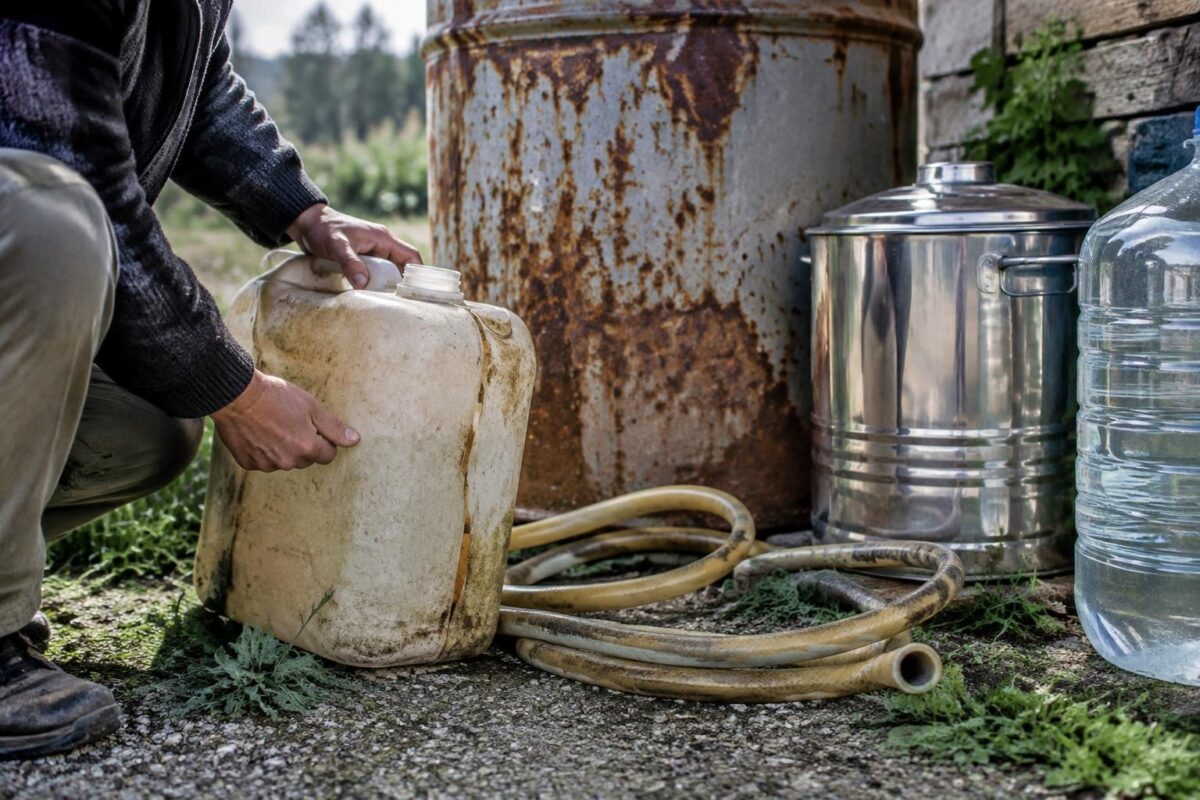
- Set aside any non-food-grade jerry cans and never reuse a container that has held a chemical product.
- Inspect every container: cracks, lingering odors, a deformed lid, or unidentified residue are reasons to replace it.
- Choose a filter suited to the water in question and check which contaminants it can actually reduce.
- Plan for a solution that does not require electricity if your pump depends on the power grid.
- Plan maintenance for cartridges, seals, and tanks according to the manufacturer’s instructions.
To organize a drinking water supply in a small space, see this guide to water independence in a tiny house; if you plan to collect rainwater, this article on rainwater harvesting systems helps distinguish water collection from water intended for drinking.
Equipment to avoid to keep your water supply safe
The most common pitfall is choosing equipment because it is readily available or inexpensive, without checking that it is suitable for drinking water. An unsuitable container can release unwanted substances, while a worn-out device can let dirt in or lose its watertight seal.
Imagine Sam, who is preparing a water supply for a country house. He finds an old DIY container and buys an uncertified water filter: even if the water looks clear, neither its taste nor its appearance proves that it is safe.
| Equipment to avoid | Why it is risky | Safer choice |
|---|---|---|
| Non-food-grade jerry can | It may contain residues or release substances not intended for drinking water. | A container labeled as suitable for food contact, clean, and fitted with an appropriate cap. |
| Uncertified water filter | Its effectiveness against microbes or chemical contaminants has not been established. | A filter with clearly documented certification and limitations of use. |
| Pump dependent on the power grid | A power outage can prevent access to water, even when the supply is full. | A manual pump or backup solution compatible with the system. |
| Non-watertight container | Leaks reduce your supply and make contamination more likely. | A sealed, intact container that is easy to clean. |
| Fragile or difficult-to-maintain equipment | A breakdown or neglected maintenance can interrupt service and degrade water quality. | Robust equipment with replaceable parts and accessible maintenance instructions. |
Water filtration: choose according to your actual needs
A filter is not a one-size-fits-all solution. Some models target particles, while others target specific microbes or substances; a device that improves the taste does not, by itself, guarantee that the water is safe to drink.
Before buying, check which contaminants the filter targets, how long the cartridges last, and the conditions for use. If the quality of the water source is unknown, have the water tested or follow public health authority recommendations: filtration does not automatically make questionable water safe to drink.
The right equipment also depends on power and maintenance
A pump that depends on the power grid may be suitable for everyday use, but it is not enough as the only way to access water in an off-grid system. A manual backup solution is easier to test before an outage than to improvise on the day.
Maintaining filtration systems is just as important as buying them. Replacing a cartridge too late, neglecting a seal, or leaving water to stagnate can reduce the system’s effectiveness; keep track of due dates and follow the manufacturer’s instructions.
Check your system in three steps
- Sort your equipment. Set aside containers of unknown origin, cracked parts, and devices with no clear indication of their intended use.
- Check compatibility. Make sure the containers are intended for drinking water and that the filter addresses the risks associated with your water source.
- Test and maintain. Check for leaks, test a way to access water without power, and keep a record of cleaning and replacement of consumables.
This check makes the system easier to understand and prevents you from mistaking clear water for safe water. When you are self-sufficient, a modest, well-managed supply is better than a collection of equipment that is impossible to monitor.
Can you use a food-grade container that has already been used?
Yes, if it has only been used to store a food product, is intact, and can be cleaned properly. Avoid any container that has held a household cleaner, fuel, or a chemical product.
Does a filter make any water safe to drink?
No. Performance varies depending on the model and the contaminants targeted. Check the certifications and limitations of use, and have an unknown water source tested when necessary.
How can you avoid a water outage during a power cut?
Do not rely solely on an electric pump: plan a manual method compatible with your system and regularly check that it works.
How often should a filter be maintained?
Follow the manufacturer’s instructions, which specify the maintenance schedule or treatment capacity. Replace worn parts and clean components according to the recommended procedure.
I hope you found these tips helpful. See you soon! — Claude