
Insulation: Water vapor can ruin everything
Hi, this is Claude. Water vapor damages insulation when it condenses inside walls or under the roof, thus reducing the energy efficiency of your home. Acting quickly to control this phenomenon will preserve your comfort and health while avoiding costly damage. Invisible water vapor easily turns into condensation when it encounters a cold surfacewhich can degrade your insulating materials.
To do immediately
- Install a suitable vapor barrier to block moisture migration.
- Ensure perfect airtightness to prevent infiltration of hot, steam-laden air.
- Use suitable insulating materials according to vapor permeability and humidity regulation.
- Identify and address thermal bridges, cold spots that are conducive to condensation.
- Maintain effective ventilation to remove indoor humidity.
In thermal insulation, it is crucial to choose between a vapor-permeable or completely airtight solution, adapted to your building and its use. Best practices to avoid internal condensation And the principles of vapor diffusion explain these choices in detail.
Why water vapor threatens your thermal insulation
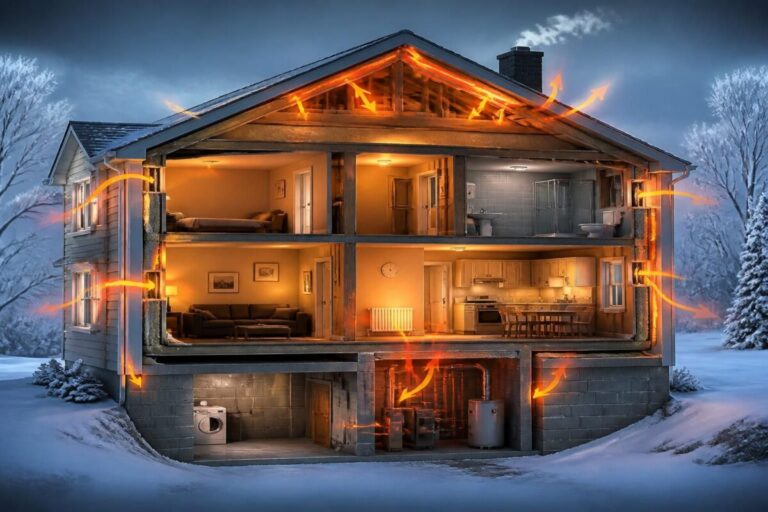
Water vapor is always present in indoor air, invisible but measurable by its humidity. When warm, vapor-laden air encounters a cold thermal bridge, the temperature drops and the vapor condenses into water droplets: this is condensation. This water then forms a trap within the insulating material, weakening its structure and reducing its energy efficiency.
If it’s on interior walls, it can create bio-based mold, which is harmful to health. If it’s in the roof, it increases the risk of premature structural deterioration. This phenomenon is all the more concerning in 2026 with the emphasis on energy-efficient renovations, where improved insulation is a major priority.
Understanding internal condensation
Insulation with vapor barrier Properly installed, it prevents warm, humid air from passing through to the cold side. Without this barrier, internal condensation within the insulation becomes inevitable.
“Ensuring airtightness is also crucial,” reminds an insulation expert. Without it, moisture circulates freely and can even amplify the thermal bridge effect.
Insulating materials: open or closed to water vapor?
Here is a table summarizing vapor permeability and their uses:
| Material type | Vapor permeability | Recommended use | Example |
|---|---|---|---|
| Natural or mineral fiber | Open | Interior walls, breathable structures | Rock wool, hemp, sheep’s wool |
| Plastic foams | Semi-hermetic | Waterproof insulation, flat roofs | PUR, XPS, phenolic foam |
| Cellular glass | Hermetic | Humid environments (sauna, swimming pool) | Cellular glass |
Choosing the right material impacts moisture management in the home. For example, natural insulation plays an active role in the humidity regulationabsorbing and then releasing water depending on the temperature.
Building with the right balance between permeability and airtightness
There’s no single best choice between vapor-permeable and airtight insulation. The key is to tailor your strategy to your specific situation. If humidity levels are very high, an airtight solution with a vapor barrier is recommended. If the house is breathable, a vapor-permeable solution will minimize condensation and promote a healthier building structure.
Without proper airtightness, even the best insulation can lose up to 50% of its effectiveness due to uncontrolled air leaks.
Steps to control steam and prevent condensation
- Step 1: Diagnose existing humidity and identify thermal bridges.
- Step 2: Choose insulating materials and vapor barrier film that are suitable for your project and the building’s intended use.
- Step 3: Carefully install the vapor barrier and ensure impeccable airtightness.
If you live in an older house, be careful: their walls are often cold and lack adequate insulation, which greatly increases the risk of condensation. In a new or renovated house, the balance between insulation and vapor management is key to a healthy and energy-efficient home.
An enlightening testimony
A family experienced recurring mold problems. After investigation, the issue stemmed from a poorly installed vapor barrier that was allowing too much moisture to pass through. Once corrected, the house regained its comfort and the energy bill decreased.
In practical terms, what can be done for sustainable insulation?
- Avoid misconceptions about thick insulation without ventilation.
- Do not neglect the value Sd of the material, a key indicator of its resistance to vapor.
- Implementing balanced ventilation is essential in any well-insulated house.
- Opt for healthy materials that promote humidity regulation.
- Regularly check for signs of condensation and act quickly.
As the golden rule of sustainable construction states: “An airtight, vapor-permeable house.” This means that vapor must be able to breathe, but without uncontrolled air leaks that could cause damage.
Once again, renovating or insulating is above all about respecting the natural balance between humidity, temperature and ventilation to ensure a healthy, comfortable and economical home.
Why install a vapor barrier?
The vapor barrier prevents the migration of warm vapor from the inside to the cold side, preventing internal condensation that damages the insulation.
What is the difference between permeable and vapor-tight insulation?
A permeable insulation allows vapor to pass through, facilitating humidity regulation, while a waterproof insulation blocks vapor to protect against very humid environments.
How to detect thermal bridges?
They often appear as cold areas on walls or ceilings, detectable with a thermal camera or when condensation is visible.
What ventilation is needed to limit humidity?
A single or double flow controlled mechanical ventilation (CMV) system is recommended to remove humidity and maintain good air quality.
Thank you for your interest; Claude