
Materials: mineral insulation or a breathable house
Hi, this is Claude. To properly insulate your house, you need to choose between effective mineral insulation or opting for a breathable house made with bio-based materials. Both approaches impact thermal performance, indoor health, and the sustainability of your home.
- Evaluate the area to be insulated: roof, walls or floor.
- Choose an insulator with good thermal resistance (R) suitable for your region.
- For areas sensitive to humidity, favour insulation materials that naturally regulate it.
- Ensures continuity of insulation and the elimination of thermal bridges.
- Promote good natural ventilation in conjunction with your insulation.
To learn more, discover the different materials used for insulation and how well choose your thermal insulation.
Mineral wool insulation, such as rock wool or glass wool, is often favored for its excellent value, durability, and fire resistance. It provides effective thermal performance with a lambda value generally between 0.032 and 0.044 W/m.K. This insulation remains a solid choice, especially in renovation projects where budgets are limited. The problem lies in its poor ability to regulate humidity and its limited thermal inertia, which can negatively impact air quality and comfort during periods of intense heat.
The home that breathes: a choice for health and indoor comfort
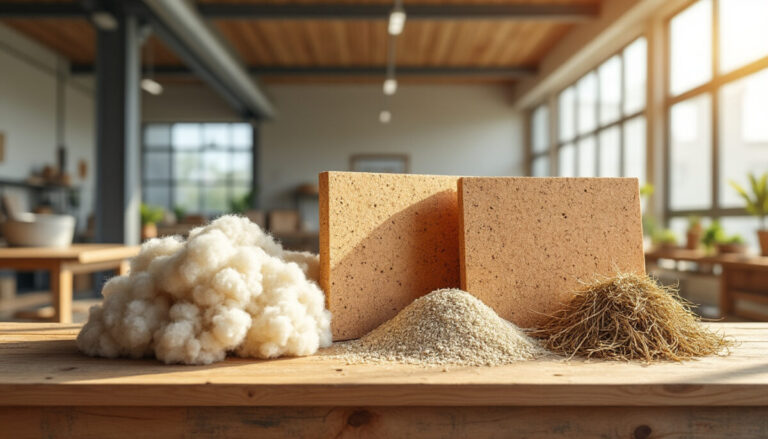
Bio-based insulation materials, on the other hand, are made from natural materials such as wood fiber, cellulose wadding, or hemp. They offer better humidity regulation, a key element for a healthy home. Their higher density provides a longer thermal lag, ensuring true summer comfort by delaying heat penetration. Their lambda values, often around 0.038 to 0.045 W/m.K, are slightly less efficient than some mineral insulation materials, but they more than compensate through natural ventilation and healthy humidity management. This approach promotes a home that breathes, with better indoor air quality and true environmental sustainability.
Quick comparison between mineral and bio-based insulation
| Criteria | Mineral insulation | Bio-based insulation (breathable house) |
|---|---|---|
| Thermal performance (lambda) | 0.032 – 0.044 W/m.K | 0.036 – 0.045 W/m.K |
| Humidity management | Weak | Excellent, natural regulation |
| Summer comfort (phase shift) | Weak | High (10-12 hours) |
| Sustainability | Good | Very good, renewable |
| Cost | Cheaper | Slight additional cost |
How to combine mineral insulation and a breathable house?
Ideally, it’s often best to combine the two types of insulation depending on the areas to be insulated. For example, rock wool is perfect for attics, while wood fiber is better suited to walls for managing moisture. The main challenge is to avoid completely sealing the house with materials that block water vapor, as this can be detrimental to indoor air quality.
- Opt for continuous insulation while limiting thermal bridges.
- Provides a suitable natural ventilation system to remove moisture.
- Prioritize durable and recyclable materials.
- Determine the thickness of the insulation according to the area concerned (10-30 cm).
- Use a professional who is a recognized environmental guarantor (RGE).
A simple procedure for a successful construction project
- Step 1: Carry out a complete energy audit to determine your needs.
- Step 2: Choose materials suitable for each wall according to its exposure and humidity.
- Step 3: Monitor the installation to ensure continuity and natural ventilation.
If it’s a renovation project with a low ceiling, opt for a mineral insulation with a low lambda value. If the house is old with fragile walls, choose a bio-based insulation that allows the facade to breathe.
An interesting anecdote: a family in southwestern France reduced their air conditioning use by 40% by switching from fiberglass insulation to wood fiber insulation with natural ventilation. “A house that breathes is a simple way to live better in harmony with our environment,” says the expert.
Anticipating sustainability and energy savings
Choosing the right insulation directly impacts long-term energy consumption. While the durability of mineral wool insulation is well-established, its energy-intensive production process increases its carbon footprint. Bio-based insulation prioritizes renewable resources and offers natural carbon storage. By 2026, it will be crucial to find a balance between thermal performance and indoor health to truly reduce energy bills while respecting the environment.
To delve deeper into this topic, you can consult the complete comparison of insulation materials and their environmental sustainability on [website address]. this guide is updated for 2025 as well as advice to promote a insulation in a breathable house.
Why choose a house that breathes?
Because it allows for better humidity regulation, improves indoor air quality and limits the risk of mold.
What are the advantages of rock wool?
It combines good thermal performance, fire resistance, and durability, making it ideal for attics or walls with technical constraints.
How to choose the necessary thickness of insulation?
The thickness depends on the lambda coefficient of the material and the target thermal resistance, generally between 10 and 30 cm depending on the application.
Are bio-based insulation materials more expensive?
They may have a higher initial cost, but provide greater comfort and a favorable environmental impact, often offset over time.
What role does natural ventilation play?
It removes indoor moisture, ensures the health of the house and maximizes the effectiveness of the insulation, especially in a house that breathes.
Thank you for your interest; Claude