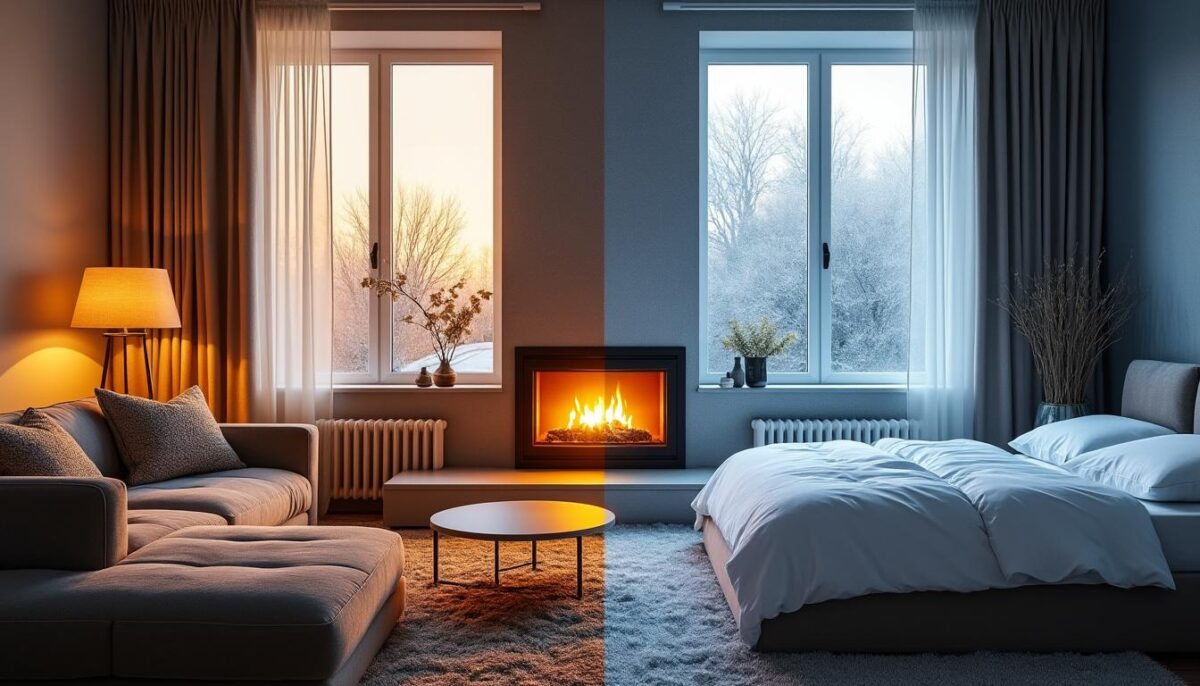
Insulation: heated living room, freezing bedroom, what to do
Hello, this is Claude. To prevent your living room from becoming an oven and your bedroom a refrigerator, start by reinforcing the insulation of the walls and windows, and eliminate thermal bridges that allow heat to escape.
To do immediately:
- Seal the windows with gaskets or insulating films.
- Install thermal curtains to retain heat.
- Identify and fill thermal bridges at the level of walls and corners.
- Use efficient and programmable heating in the bedrooms.
- Control and improve ventilation to limit humidity and heat loss.
You can discover other practical tips for fighting the cold and improving insulation in this article on How to insulate a room from the cold effectively or explore simple solutions for theroom insulation.
The main causes of a heated living room and a cold room
Heat loss is often uneven. A living room, with good exposure and better furnishings, benefits from more effective thermal insulation than a bedroom located further from the heat source. A thermal bridge, meaning a weak point in the insulation, often found on walls or around windows, accelerates the cooling process in the bedroom, even with the heating on full blast. A cold wall can lead to a feeling of intense cold, far exceeding the temperature displayed.
In some cases, poor ventilation exacerbates the problem by allowing humidity to accumulate, which further cools the room. To avoid multiplying your energy bill, improving insulation is crucial and often more economical than increasing the heating system’s output.
The key role of wall and window insulation
We often talk about insulation, but it’s the walls that can really keep you warm. Good wall insulation significantly reduces heat loss. For bedrooms, interior insulation is the easiest to implement. Furthermore, poorly insulated windows can be a major source of heat loss, especially if they are single-glazed or old.
To illustrate, I saw in a recently isolated country house that installing high-performance double glazing in the bedroom made it possible to gain several degrees without changing the heating.
Rapid and lasting interventions to rebalance the temperature
- Insulate from the inside Using special panels or placo-mineral wool linings can make the room warmer without major work.
- Check and replace the seals around windows and doors to prevent cold air infiltration.
- Install an efficient auxiliary heating system and regulated in the room to quickly counteract the cold.
- Install thermal curtains which prevent the cold from penetrating during the night.
- Identify thermal bridges using an infrared thermometer to take the most precise action.
If the room is in the attic…
Poorly insulated ceilings often allow a large amount of heat to escape. Reinforcing the roof insulation or installing an insulated false ceiling is essential.
If the walls are damp or in contact with the outside…
Installing specific thermal insulation on the exterior walls, or laying anti-humidity membranes, will improve your thermal comfort in the long term.
3-step procedure for effective insulation
- Diagnosis: Accurately identify cold spots, thermal bridges and insulation defects, using the appropriate equipment or by a professional.
- Targeted intervention: Apply solutions tailored to each area, such as installing insulating panels, caulking, or installing double glazing.
- Optimization: Improve ventilation to limit humidity, and adjust heating management for lasting comfort.
A proverb says: “Prevention is better than cure.” Investing in well-designed thermal insulation avoids high bills and protects your health.
Comparison of floor and wall insulation: advantages and disadvantages
| Type of insulation | Benefits | Disadvantages |
|---|---|---|
| Extruded polystyrene (XPS) | Good moisture resistance, rigid, thermal class A | Not very eco-friendly, not breathable |
| Glass wool | Dual thermal and acoustic use, economical | May cause irritation upon application, loses effectiveness if exposed to moisture |
| Cellular concrete (granules) | Insulating and leveling, good resistance | Higher cost, more complex installation |
| Thermal curtains | A quick and cost-effective solution | Less effective than structural insulation |
How to identify a thermal bridge
Use an infrared temperature detector or observe the walls if they are cold to the touch, often at the junctions of walls and windows.
Should we prioritize insulation from the inside or the outside?
Exterior insulation is more effective but more expensive. Interior insulation remains a good solution, especially for renovations.
How to prevent moisture buildup through insulation?
Make sure you ventilate the room well and use insulation suitable for humidity, such as rock wool.
Is it possible to insulate a floor without major construction work?
Yes, with solutions such as dry screed or insulation from below if access to the crawl space is possible.
What are the signs of poor insulation?
Cold rooms despite heating, damp walls, condensation on windows, and periods of high energy bills.
Thank you for your interest; Claude